Map activities instead of counting toys
Draw the existing habitat and mark where the hamster sleeps, digs, travels, drinks, and runs. Look for a missing opportunity rather than an empty-looking corner. A good burrowing zone may look plain above ground but be one of the most useful parts of the enclosure. Avoid filling it with objects simply because a photograph looks unfinished.
List each proposed addition by its purpose. A tunnel provides a route, a hide provides cover, and a suitable scatter-feeding area creates a search opportunity. One object may serve more than one purpose. If a new item blocks the route to water or makes the wheel difficult to inspect, reconsider its location before introducing it.
Inspect simple materials as carefully as purchases
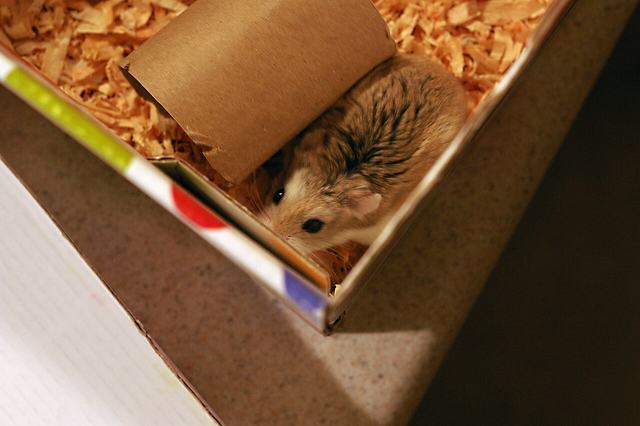
A clean, plain cardboard box can create an inexpensive hiding or exploration opportunity. Remove tape, staples, loose labels, and unsuitable packaging inserts. Make openings comfortably large enough for the individual hamster. Do not assume any cardboard item is appropriate: reject packaging with residue, strong odours, sharp edges, or materials you cannot identify.
For purchased items, read the intended species and dimensions. Inspect seams, small detachable pieces, loops, and narrow gaps. Look at the object from the animal's height instead of only from above. A decorative bridge that looks attractive may create a fall or entrapment risk if its construction or placement is unsuitable.
Use food within the normal feeding plan
Set aside part of the usual appropriate dry ration for easy foraging opportunities. At first, place it where it can be found without solving a difficult puzzle. Avoid turning enrichment into extra meals that are never counted. Keep a record of what is offered when several people share care duties.
Keep perishable food easy to retrieve and follow the established diet plan. Do not pack unfamiliar ingredients deep inside a structure that cannot be inspected. If the hamster has a medical feeding plan or difficulty moving, ask the vet how to adapt enrichment. Accessibility matters more than making a challenge harder.
Introduce one change and watch what happens
Keep essential resources and the main sleeping arrangement predictable while trying a new activity. Place the addition securely and observe from outside the enclosure during a normal waking period. Note whether it is explored, ignored, blocked, or chewed in a way that changes its structure. Remove an item that becomes unstable, wet, or damaged.
Do not measure success only by immediate interest. A cautious animal may investigate later, and an item can be useful as cover without becoming the centre of activity. Photograph the arrangement and review it after several days. Change one variable at a time so you can understand the effect rather than repeatedly rebuilding the entire habitat.
Photograph the layout before a change and note exactly what you moved. Check access again from outside after the hamster has explored, because bedding movement may alter an entrance or route. If you remove an unsuccessful addition, return the essential arrangement to its familiar position. A small, reversible trial is easier to evaluate than rebuilding several areas at once.
Keep a rotation that you can maintain
Store a small number of clean spare items in a labelled container. Record anything that needs replacing, and check reusable items before they return to the habitat. Do not rotate bedding, hides, routes, and food presentation all at once. Keep safe favorites available when they are in good condition. The most useful enrichment plan is one that supports everyday behaviour and remains easy to inspect.
Keep it practical
Your checklist
- Map burrowing, hiding, running, travel, and foraging opportunities.
- Keep water access and inspection routes clear.
- Remove fasteners, residue, sharp edges, and trapping gaps.
- Count food activities within the normal feeding plan.
- Try one change at a time and remove damaged materials promptly.
Sources & further reading
Sources offer further context; a link is not an endorsement of this publication. This guide is general information and does not replace care from a vet familiar with your animal.
See our editorial policy and commercial disclosure. Please tell us about an error.