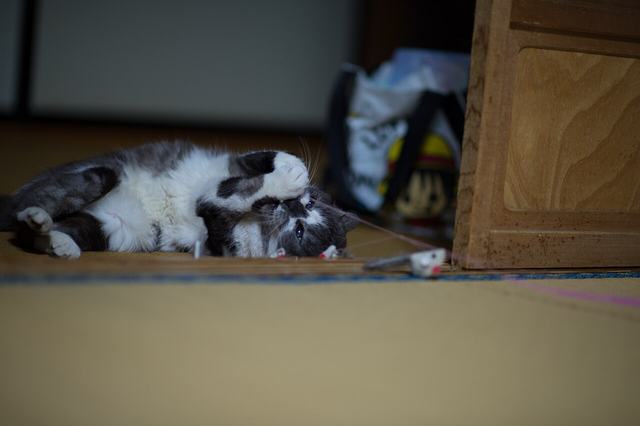
Learn the cat's preferred starting point
Notice when the cat naturally becomes interested in movement or explores the room. Record the surfaces and spaces it chooses. Some cats engage from behind cover, while others investigate an object in an open area. Use that information to arrange a comfortable starting place for play.
Do not interpret a lack of immediate pursuit as a reason to move the toy more aggressively toward the cat's face. Pause and offer space. If interest or mobility changes noticeably from the cat's usual pattern, arrange veterinary advice instead of assuming that a more expensive toy is the answer.
Prepare the space before opening the toy box
Remove breakable objects and check the floor for items that could be swallowed or tangled. Leave an easy route out of the activity area. If more than one cat lives with you, consider whether each can participate without competing at a narrow doorway or being crowded by the other.
Choose toys appropriate to the cat and inspect them before use. Set aside damaged pieces. String-like toys and similar items need careful supervision and secure storage after the session. Follow product warnings; a claim that a toy is interactive does not mean it is safe to leave accessible unattended.
Use movement the cat can choose to follow
Try controlled movements along the floor or around suitable cover, with pauses that allow the cat to watch and decide. Keep the activity manageable for the individual's ability. You do not need to keep the toy moving constantly or turn every session into a strenuous chase.
Allow successful interaction with a tangible toy when appropriate and finish calmly. Watch for signs that the cat wants to stop or leave. End the session without pursuing it into a resting place. Predictable opportunities for positive play are more useful than one exhausting burst followed by several days with no engagement.
Rotate a small selection deliberately
Keep a few safe options accessible as appropriate and store supervised toys securely. Change the available selection based on use and condition, rather than putting out every new item at once. A small rotation makes it easier to recognize what engages the cat and what simply occupies the floor.
Clean and replace toys according to their materials and instructions. If using food-based activities, account for the food within the cat's feeding plan and discuss dietary restrictions with a vet. Avoid introducing unknown treats or materials solely because a social post describes an enrichment hack.
Make the routine transferable
Write a brief play note for anyone caring for the cat: preferred toy, where it is stored, suitable play area, and how the cat usually ends the interaction. Include any item that must be put away. A sitter should not need to discover by trial and error that the most tempting toy requires supervision.
Review the arrangement when your schedule changes. Put a realistic opportunity near an existing daily habit so it is easier to remember. Observe participation over time without turning play into a performance score. The objective is a pleasant, adaptable part of ordinary care.
Keep it practical
Your checklist
- Observe preferred times, locations, and styles of play.
- Clear hazards and preserve an easy exit from the play area.
- Inspect toys and supervise items that could tangle or be swallowed.
- Use pauses and let the cat choose whether to engage.
- Rotate appropriate toys and store supervised items securely.
- Leave a simple, individualized play note for the cat sitter.
Sources & further reading
Sources offer further context; a link is not an endorsement of this publication. This guide is general information and does not replace care from a vet familiar with your animal.
See our editorial policy and commercial disclosure. Please tell us about an error.